| |
THE
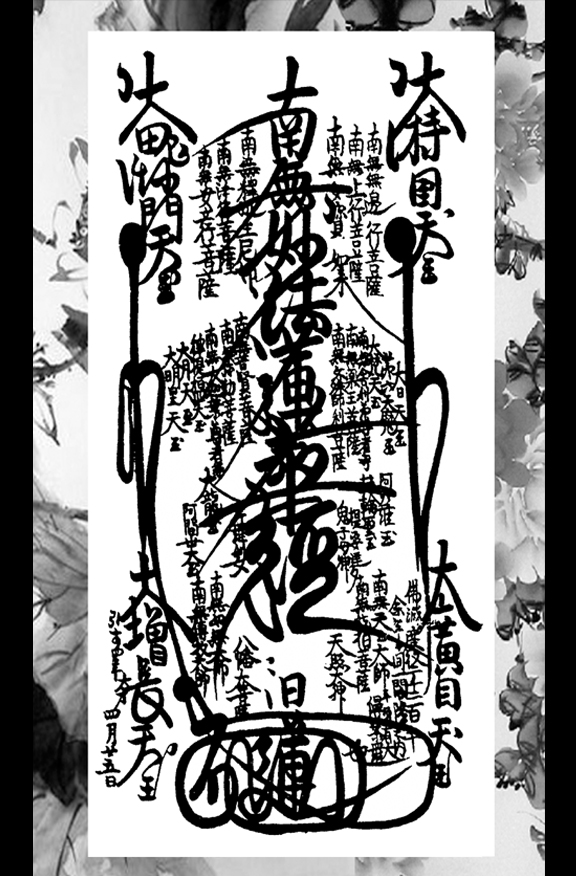
GOHONZON

To practice correctly, a perfect mirror of our Buddha
life condition was created to enable all human beings to more easily
connect with the life condition of Buddha.
To accept and practice to this Ultimate mandala requires respect
for all life and for this mandala as it represents the essential
core of your life as well as all others. The preparatory ceremony
to "connect" the practitioner to their specific copy of
this mandala, called the GOHONZON, or ultimate object of devotion,
is called Gojukai.
Below is a description of the Gojukai ceremony, and a link to a
PDF version of the above GOHONZON for you to print and frame securely
or best yet, to build an altar for in your home. There can be no
other objects around your GOHONZON! No football trophies, no diplomas,
no tiki wall decor, absolutely nothing. You may offer only white
candles and pure incense when chanting. Protect this GOHONZON as
though it were your life. For more on this see "On
attaining Buddhahood".
Gojukai"(receiving the precept) is the ceremony performed
when someone takes faith in Buddhism. Those determined to start
their practice of True Buddhism should receive Gojukai.
Although Buddhism is said to have some 80,000 volumes of teachings,
they all boil down to three fundamentals known as the three types
of learning.
These are the precepts (kai), which are intended to stem injustice,
stop evil and promote good; meditation (jo), which is the concentration
of one's mind in order to master the profound truth inherent in
life; and wisdom (e), which allows a person to distinguish and choose
between good and evil, right and wrong, the true and the false,
and to put him or her on a higher plane.
Precepts, far more than meditation and wisdom are directed towards
putting Buddhism into practice within one's life.
To be able to avoid evil and conduct themselves properly, people
need to be taught the difference between good and evil. People need
to practice something to transform unhappiness into happiness, move
from evil to good, deepen their Buddhist practice, and purify their
lives.
In Buddhism generally, the Five Precepts are accepted. These are:
(1) not to kill living things, (2) not to lie, (3) not to steal,
(4) not to engage in illicit sexual acts, and (5) not to drink intoxicants.
In Shakyamuni's Buddhism, there are many precepts enacted based
on these five. In Hinayana Buddhism, there are the eight precepts,
the ten precepts, the 250 precepts for monks and the 500 precepts
for nuns. In Provisional Mahayana, there are the ten major precepts
and the forty-eight minor precepts. All of these precepts were contained
in Shakyamuni's earlier teachings, so they are integrally connected
with Shakyamuni's use of provisional means to teach the people.
Shakyamuni later went on to teach the Lotus Sutra, the true way
to Buddhahood, at which time he revealed that the most fundamental
precept is contained in the practice of embracing the Lotus Sutra.
This is why the many precepts of the provisional teachings are not
the core of Buddhism, neither in Shakyamuni's lifetime nor in the
Latter Day of the Law.
Nichiren Daishonin's Buddhism, the Buddhism of Sowing, teaches
that, in the deepest meaning of Shakyamuni's Lotus Sutra, the basis
of all precepts lies in single-mindedly embracing the Dai-Gohonzon
of the Three Great Secret Laws and persevering in faith throughout
one's life. The "Orally Transmitted Teachings" (Ongi kuden)
refers to the Dai-Gohonzon when it states:
The doctrinal basis of the Gohonzon derives from the phrase of
the Juryo chapter, "The Tathagata's secret and his mystic power"
(Nyorai Hi-mitsu Jinzu-shi-riki). It signifies the three types of
learning and the theoretical Three Great Secret Laws of the Juryo
Chapter.(Gosho, p. 1773)
This indicates that the Dai-Gohonzon established by Daishonin is
equal to the three types of learning. Embracing the Dai-Gohonzon
of the Sowing hidden in the depths of the Juryo Chapter, which Nichiren
Daishonin propagated, is the basis of all precepts in the Latter
Day of the Law. This is the meaning of the principle, "to embrace
faith is to keep the precepts."
The "Treasure Tower" (Hoto-11th) Chapter of the Lotus
Sutra says:
It is difficult to sustain faith in this sutra. One who embraces
it even for a short time will delight me, Shakyamuni, and all other
Buddhas. A person like this will be praised by all Buddhas. This
is what is meant by courage; this is what is called "consistently
observing the precepts."(Kaiketsu, p. 353)
Nichiren Daishonin also teaches about this in "The True Object
of Worship":
Shakyamuni's practices and the virtues he attained thereby are
all contained within the five characters of Myoho-Renge-Kyo. If
we believe in them, we shall naturally be granted the same benefits
as he was.(Gosho, p. 653) The Gosho, "Teaching, Practice and
Proof" states: The five characters of Myoho-Renge-Kyo which
are the heart of the Essential Teaching of the Lotus Sutra (Honmon),
contain all the benefits amassed by the beneficial practices and
meritorious deeds of all the Buddhas of the past, present, and future.
Thus, how can this phrase not include the Buddha's precepts? Once
the practitioner embraces this perfectly endowed mystic precept,
he cannot break it, even if he should try. Therefore, it is called
the precept of the diamond chalice.(Gosho, p. 1109)
The Myoho-Renge-Kyo referred to in the first line is not the Mystic
Law of the Juryo Chapter of the Buddhism of the Harvest during Shakyamuni's
lifetime, but the Myoho-Renge-Kyo of the Juryo chapter of Sowing
of the True Buddhism of Mappo. It is the Daishonin's Daimoku.
This Gosho teaches that once a person places his or her faith in
the Gohonzon and earnestly chants Daimoku, that person instantly
receives all of the same limitless benefit received by the Buddhas
of the Three Existences through their long practices. Once you've
been invested with this mystic Law, it becomes a part of you. No
matter what happens, it can not be broken by you or anyone else.
Even if you give up your faith and fall into the evil paths, you'll
still -- through the merit of this precept -- re-encounter Buddhism
some day and be able to gain eternal control over your life. For
this reason, this mystic precept is called the "precept of
the diamond chalice" or the "diamond precept" because,
like a diamond, it cannot be broken.
The text of the Honmon kaitai sho makes it clear that Nichiren Daishonin
Himself also received Gojukai:
I (Nichiren) asked myself three times if I would discard the precepts
of the pre-Lotus Sutra teachings and keep the precept of the infinite
past of kuon as described in the Juryo Chapter of the Lotus Sutra
with my present body as a common mortal until the time I would attain
the body of a Buddha. I swore I would.(Gosho, p. 1442)
The Gojukai ceremony must be conducted by a priest, before the Gohonzon
in a Nichiren Shoshu temple, or, in places where there are no temples
yet, before a Joju Gohonzon specifically enshrined for the occasion.
Before the Gohonzon, recipients are to receive the precept by making
vows as directed by the priest. In these vows, Gojukai recipients
honestly agree to discard all the mistaken doctrines of provisional
teachings and the incorrect theories of mistaken teachers and vow
to sincerely embrace the Gohonzon and to practice True Buddhism.
The priest holds the Gohonzon over the head of each Gojukai recipient.
The pledge is divided into three parts, after each of which the
phrase "I do" is recited by the recipients and everyone
present at the ceremony.
In Nichiren Shoshu, Gojukai has two functions: kai (a precept: to
stem injustice and to stop evil) and kan (encouragement: to encourage
a person to embrace True Buddhism). Gojukai recipients need to be
committed to carrying out pure faith for the rest of their lives.
They must be ready to completely give up any previous religion and
discard all ties to it, including its heretical literature and images.
Anyone can receive the Gojukai ceremony. This is through Nichiren
Daishonin's great compassion as the True Buddha who established
True Buddhism to save all humanity. Only the Daishonin's Buddhism
can lead us, the common mortals of Mappo, to enlightenment.
Thus, in Nichiren Shoshu, the precept pledge has been created based
on the fundamental concept of discarding the evil and establishing
the good. Discarding all the mistaken doctrines of the provisional
teachings is shaku (discarding the evil) and embracing and practicing
to the Three Great Secret Laws is jizen (establishing the good).
This is why the Gojukai ceremony is carried out for the recipients.
The Gojukai ceremony is essential to enable people to reform their
lives. It is therefore important for both the priesthood and the
laity that the ceremony be conducted with the utmost solemnity and
sincerity.
PDF of final Nichiren GOHONZON
|